


Vacuum Hardening in India: Complete Guide for Manufacturers
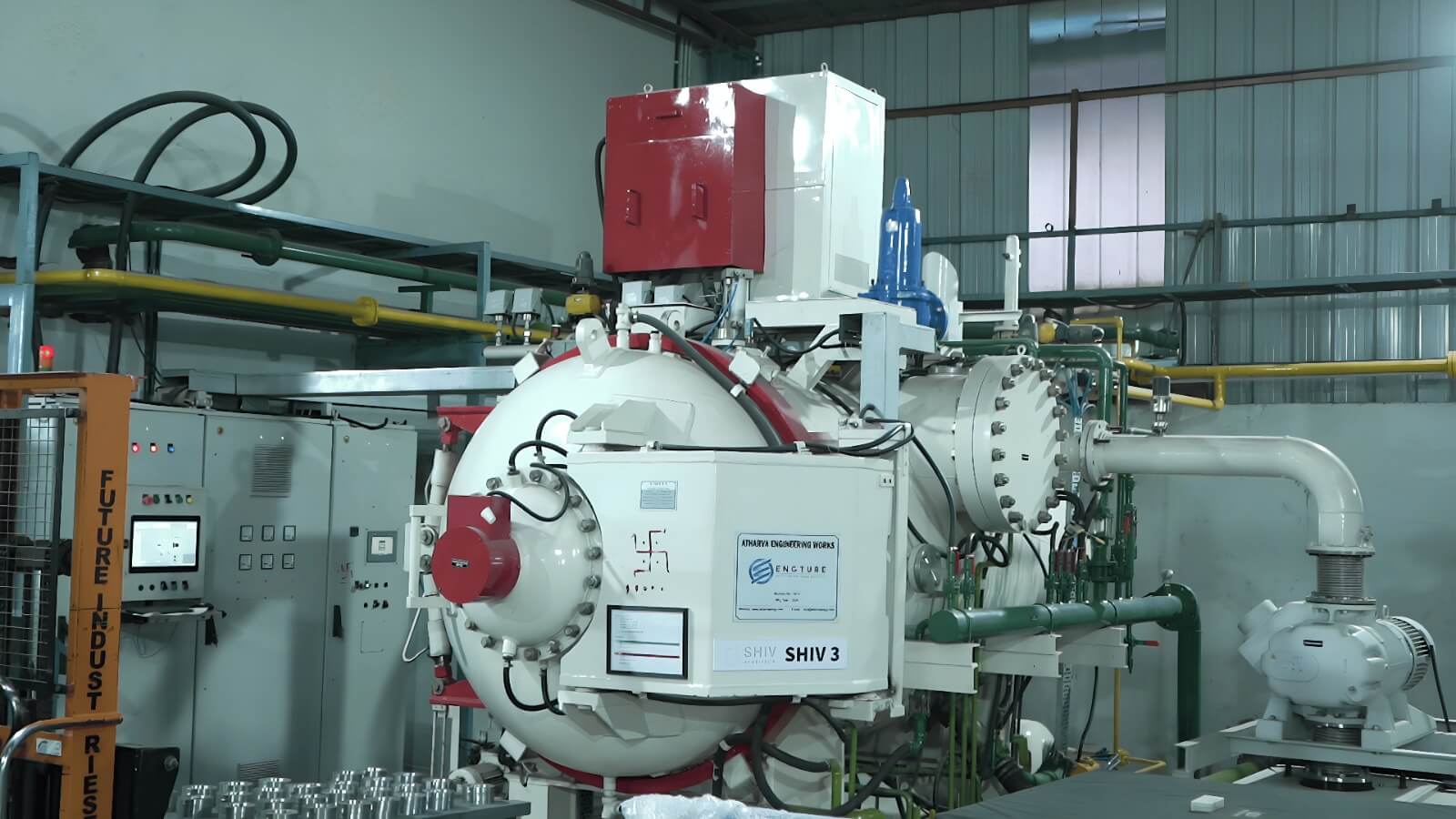
Table of Contents
Introduction
In the world of precision manufacturing, the difference between a component that lasts and one that fails under stress often comes down to one critical process: Vacuum Hardening.
For Indian manufacturers in aerospace, automotive, defense, and heavy engineering sectors, understanding and leveraging vacuum hardening technology can mean the difference between meeting international standards and falling short of customer expectations.
This guide explains the vacuum hardening process, its benefits, and how manufacturers in India can use it to produce high-performance components.
What is Vacuum Hardening?
The Basics
Vacuum hardening is an advanced heat treatment process that improves hardness, wear resistance, and dimensional accuracy of steel components without oxidation or surface damage.
During the process:
- Components are placed in a vacuum chamber.
- Temperature is raised to 800-1200°C depending on steel grade.
- The vacuum environment prevents oxidation.
- Components are cooled using pressurized inert gas.
- The result is a stronger and more durable component.
The "vacuum" part is crucial. By removing air and oxygen from the treatment chamber, manufacturers eliminate the chemical reactions that normally cause surface degradation during conventional hardening—which can lose valuable material and reduce component lifespan.
Vacuum Hardening vs Conventional Hardening
| Aspect | Vacuum Hardening | Conventional Hardening |
|---|---|---|
| Oxidation | None - vacuum environment | Surface scaling occurs |
| Surface Quality | Clean, no decarburization | May require post-treatment |
| Dimensional Accuracy | ±0.1mm precision | Higher distortion |
| Component Size Limit | Can handle complex shapes | Limited to simpler geometries |
| Quality Consistency | Highly repeatable | More variable |
| Cost | Higher per unit | Lower per unit |
| End-Use Quality | Premium aerospace/defense grade | Standard industrial grade |
Key takeaway: Vacuum hardening costs more but delivers superior results for precision applications.
The Vacuum Hardening Process Explained
Step 1: Material Preparation
- Components are cleaned of contaminants.
- Oxidation layers are removed.
- Parts are loaded into the vacuum furnace.
- The chamber vacuum is reduced to extremely low pressure.
Step 2: Heating Phase
- Temperature increases gradually.
- Thermocouples monitor heating precisely.
- This prevents distortion or thermal shock.
- Steel grade determines target temperature:Tool Steel800-950°CAlloy Steel850-1100°CStainless900-1050°C
Step 3: Soaking Phase
- Component held at target temperature for specific time.
- Allows heat to penetrate entire component depth.
- Duration depends on component size and steel grade.
- Typical soak time: 15-45 minutes
Step 4: Quenching Phase
- Nitrogen or argon gas pressurized and introduced.
- Rapid cooling occurs.
- Vacuum + inert gas = no oxidation during critical cooling
- Cooling rate is crucial—too fast causes distortion, too slow reduces hardness
Step 5: Tempering Phase
- Component reheated to lower temperature (200-650°C)
- Reduces brittle hardness, improves toughness
- Ensures component won't crack under real-world stress
- Temperature selected based on required hardness vs. toughness balance
Step 6: Cooling & Unloading
- Component cooled to room temperature
- Removed from chamber
- Ready for quality inspection and use
- Ready for quality inspection and use
Critical Temperature Control
The accuracy of temperature control is everything in vacuum hardening. Even a 5°C variation can significantly affect:
- Final hardness (measured in HRC—Rockwell Hardness)
- Toughness and impact resistance
- Component lifespan
- Performance in critical applications
Modern furnace technology uses:
Multiple thermocouples monitoring temperature
PLC systems ensuring ±2°C accuracy
Continuous recording for quality traceability
Automatic adjustments during heating/cooling cycles
Industries & Applications Using Vacuum Hardening in India
Aerospace Industry
Aircraft components operate under extreme stress, temperature variations, and fatigue cycles. A single component failure can be catastrophic.
Components treated
- Turbine blades and discs
- Landing gear components
- Fasteners and rivets
- Hydraulic actuator parts
- Engine mounting brackets
Requirements
- Precise hardness (HRC 42–48)
- Zero surface defects
- AS9100 compliance
Benefit: Enhanced fatigue resistance means components last longer between maintenance.
2. Automotive Industry
Modern vehicles demand components that withstand millions of duty cycles without failure.
Components treated
- Camshafts and crankshafts
- Gears and transmission components
- Axle shafts and steering components
- Fasteners, bolts, and valve lifters
Requirements
- High hardness (HRC 58-62)
- Wear resistance & dimensional stability
- IATF 16949 certification
Benefit: Improved wear resistance and fatigue life for critical engine and transmission parts.
3. Defense & Military
Defense applications demand uncompromising reliability. Equipment must perform in extreme conditions.
Components treated
- Firearm parts and mechanisms
- Armor and Artillery parts
- Military vehicle components
- Precision tool inserts & Munition bodies
Requirements
- Military-grade strength & reliability
- Strict adherence to specifications
- Full documentation and traceability
Benefit: Unmatched reliability and performance in the most demanding field environments.
4. Heavy Engineering
Capacity for massive components (100+ kg) requiring high-temperature strength over a long operational life.
Components treated
- Turbine rotor components
- Pump shafts and impellers
- Compressor blades
- Bearing races and sleeves
Requirements
- High-temperature strength
- Fatigue resistance (10+ year life)
- ISO 9001 & ISO 14001 reliability
Benefit: Reliable performance for massive internal components under high-temperature stress.
5. Tools & Dies
Extreme hardness and toughness required to prevent chipping during high-volume metal forging and cutting.
Components treated
- Metal cutting tools
- Injection molding & Stamping dies
- Forging dies and Precision gauges
Requirements
- Extreme hardness (HRC 62-65)
- Toughness to prevent chipping
- Dimensional batch accuracy
Benefit: Significant extension of tool life and reduced downtime in high-volume production.
6. Medical Devices
Surgical and electronic components requiring extreme precision (±0.05mm) and biocompatible properties.
Components treated
- Surgical instrument blades
- Precision springs & Connector pins
- Electronic contact components
- Implant components
Requirements
- Extreme precision (±0.05mm)
- Corrosion resistance
- ISO 13485 medical certification
Benefit: Ultra-precise, sterile-ready components that meet the highest surgical standards.
Key Benefits
No Oxidation
Vacuum prevents scale formation and material loss. Surface equals core hardness.
Minimal Distortion
Controlled cooling maintains tight tolerances (0.1mm typical warping).
Improved Properties
Higher hardness, better toughness, and 2-3x longer component life.
Complex Geometries
Treat intricate shapes like internal channels without distortion.
Environment Friendly
No hazardous emissions or oil quenching required. ISO 14001 compliant.
How to Choose a Provider
1. ISO Certifications
Look for: ISO 9001, AS9100D, and NADCAP accreditations.
What to ask about
- Equipment maintenance history
- Temperature accuracy (±2°C)
- Maximum size capacity
- Backup furnace availability
Red Flags
- Old, unrefurbished equipment
- Vague technical specifications
- Lack of maintenance logs
- Single-furnace operations
Metallurgist on staff
Full traceability
5-7 day turnaround
Frequently Asked Questions
Q: How much does vacuum hardening cost?
A: Small components (<1kg) typical ₹200–500/piece. Volume pricing often ₹100–300/kg.
Q: How long does the process take?
A: Actual furnace time 2-12 hours. Standard turnaround 5-7 days.
Q: What steel grades can be treated?
A: Tool steels (D2, A2), Alloy steels (4140, 4340), Stainless (440C), and specialty alloys.
Q: Will my component distort?
A: Distortion is minimal (typically <0.1mm) but depends on section thickness and geometry.
Conclusion
Vacuum hardening represents a significant technological advancement in heat treatment, enabling Indian manufacturers to compete globally with precision components that meet the most stringent international standards.
Whether you're manufacturing aerospace components that must operate flawlessly at altitude, automotive parts that need to survive millions of duty cycles, or defense equipment that must never fail, vacuum hardening delivers the hardness, durability, and precision your components demand.
The investment in quality heat treatment pays dividends through:
- Extended component lifespan
- Reduced field failures and warranty costs
- Ability to serve premium market segments
- Competitive advantage over domestic competitors
- Access to international export markets
Getting Started: How to Request a Quote
3 Simple Steps to Precision Heat Treatment
Step 1: Contact Us
- •Phone: +91 9274304223
- •Email: sales@shivheattech.com
- •Website: www.shivheattech.com
Step 2: Provide Details
- •Material type (steel grade)
- •Dimensions and weight
- •Target hardness (HRC)
- •Quantity needed
- •Timeline / Turnaround
- •Special requirements
Step 3: Get Your Quote
- •We'll confirm specifications
- •Provide competitive pricing
- •Schedule treatment
- •Support throughout process
Next Steps
Or speak with an expert
+91 927 430 4223